> ## Documentation Index
> Fetch the complete documentation index at: https://dev.writer.com/llms.txt
> Use this file to discover all available pages before exploring further.
# Microsoft Azure
> Add AI models from Microsoft Azure to use in AI Studio agents
This guide shows you how to configure Microsoft Azure as an external model provider in AI Studio. After setting up this provider, you can use Azure OpenAI models or Foundry Models when building agents.
## Prerequisites
Before adding Microsoft Azure models to AI Studio, you need:
* An [Azure subscription](https://azure.microsoft.com/pricing/purchase-options/azure-account?cid=msft_learn) with access to Azure OpenAI or Foundry Models
* At least one deployed model on your Azure resource (see [setup options](#choose-a-setup-path) below)
* The resource endpoint and API key for the deployment you plan to use
AI Studio supports **text generation** and **embedding** models from Microsoft Azure. Video, audio, and image generation models are not supported.
AI Studio currently supports the following Azure models, with more coming soon:
* `gpt-4.1`
* `gpt-4o`
* `gpt-5`
* `mistral-large-3`
To request a model, reach out to your account manager or [support](mailto:support@writer.com).
## Choose a setup path
Choose one of the following setup paths depending on how you deploy models in Azure:
* **[Azure OpenAI](#option-1-azure-openai)**: Create an Azure OpenAI resource and deploy models through the Azure portal
* **[Foundry Models](#option-2-foundry-models)**: Deploy models through the Foundry portal
## Option 1: Azure OpenAI
### Create a resource
Create an Azure OpenAI resource in the Azure portal before deploying models.
1. Sign in to the [Azure portal](https://portal.azure.com)
2. Select **Create a resource** and search for **Azure OpenAI**
3. Select **Create**
4. On the **Basics** tab, provide the following:
| Field | Description |
| ------------------ | --------------------------------------------------------------------------------------------------- |
| **Subscription** | The Azure subscription to use for your Azure OpenAI resource |
| **Resource group** | The resource group to contain your Azure OpenAI resource. Create a new group or use an existing one |
| **Region** | The location for your resource. Different regions may introduce latency |
| **Name** | A descriptive name for the resource, such as `writer-aistudio-openai` |
5. Select **Next**
6. On the **Network** tab, select **All networks, including the internet, can access this resource** (required for AI Studio to reach the endpoint)
7. Select **Next** to open the **Tags** tab. Add [tags](https://learn.microsoft.com/en-us/azure/azure-resource-manager/management/tag-resources) if your organization requires them
8. Select **Next** to reach **Review + submit**
9. Confirm your settings and select **Create**
For more details, see [Create and deploy an Azure OpenAI resource](https://learn.microsoft.com/en-us/azure/foundry-classic/openai/how-to/create-resource?pivots=web-portal) on Microsoft Learn.
### Deploy a model
Before you can use a model in AI Studio, you need to deploy it on your Azure OpenAI resource.
1. Sign in to [Microsoft Foundry](https://ai.azure.com)
2. Navigate to the Azure OpenAI resource you [created earlier](#create-a-resource)
3. Select **Deployments** from the left pane
4. Select **+ Deploy model** > **Deploy base model**
5. Select the model you want to deploy and select **Confirm**
6. Set the **Deployment name**, which is the name you use in API calls and the value AI Studio maps to your model
7. Select **Deploy**
8. Wait until the **Provisioning** state changes to **Succeeded**
For more details on deploying models on Azure OpenAI resources, see [Deploy a model](https://learn.microsoft.com/en-us/azure/foundry-classic/openai/how-to/create-resource?pivots=web-portal).
## Option 2: Foundry Models
### Create a Foundry project
Foundry Models are deployed within a Foundry project. Create one if you don't already have a project.
1. Sign in to [Microsoft Foundry](https://ai.azure.com). Ensure the **New Foundry** toggle is **on**
2. Select **+ New project** from the top navigation
3. Enter a **Project name**
4. Expand **Advanced options** to configure:
| Field | Description |
| -------------------- | ------------------------------------------------------------------------------------------------- |
| **Foundry resource** | The Foundry resource that manages this project |
| **Region** | The Azure region for the project (for example, **East US 2**) |
| **Subscription** | The Azure subscription to bill against |
| **Resource group** | The resource group to contain the project resources. Select an existing group or create a new one |
5. Select **Create**
For more details on creating Foundry projects, see [Create a Foundry project](https://learn.microsoft.com/en-us/azure/foundry/how-to/create-projects?tabs=foundry).
### Deploy a model
1. From the Foundry portal homepage, select **Discover** in the upper navigation, then **Models** in the left pane
2. Select a model and review its details
3. Select **Deploy** > **Custom settings** to configure the deployment (or **Default settings** for quick setup)
4. For partner and community models, read the terms of use and select **Agree and Proceed** to subscribe through Azure Marketplace
5. Set the **Deployment name**, which is used in API calls and the value AI Studio maps to your model
6. Select **Deploy**
7. Wait until the deployment status shows **Succeeded**
For more details, see [Deploy Foundry Models](https://learn.microsoft.com/en-us/azure/foundry/foundry-models/how-to/deploy-foundry-models) on Microsoft Learn.
## Retrieve the target URI and API key
After deploying a model through either setup path, navigate to the deployment to copy your credentials.
1. In the Foundry portal, navigate to the model you deployed
2. Copy the **Target URI** and **API Key** from the deployment details to [use in AI Studio](#add-microsoft-azure-models-in-ai-studio)
Store your API key securely. If a key is compromised, rotate it from the deployment detail page or the Azure portal.
## Add Microsoft Azure models in AI Studio
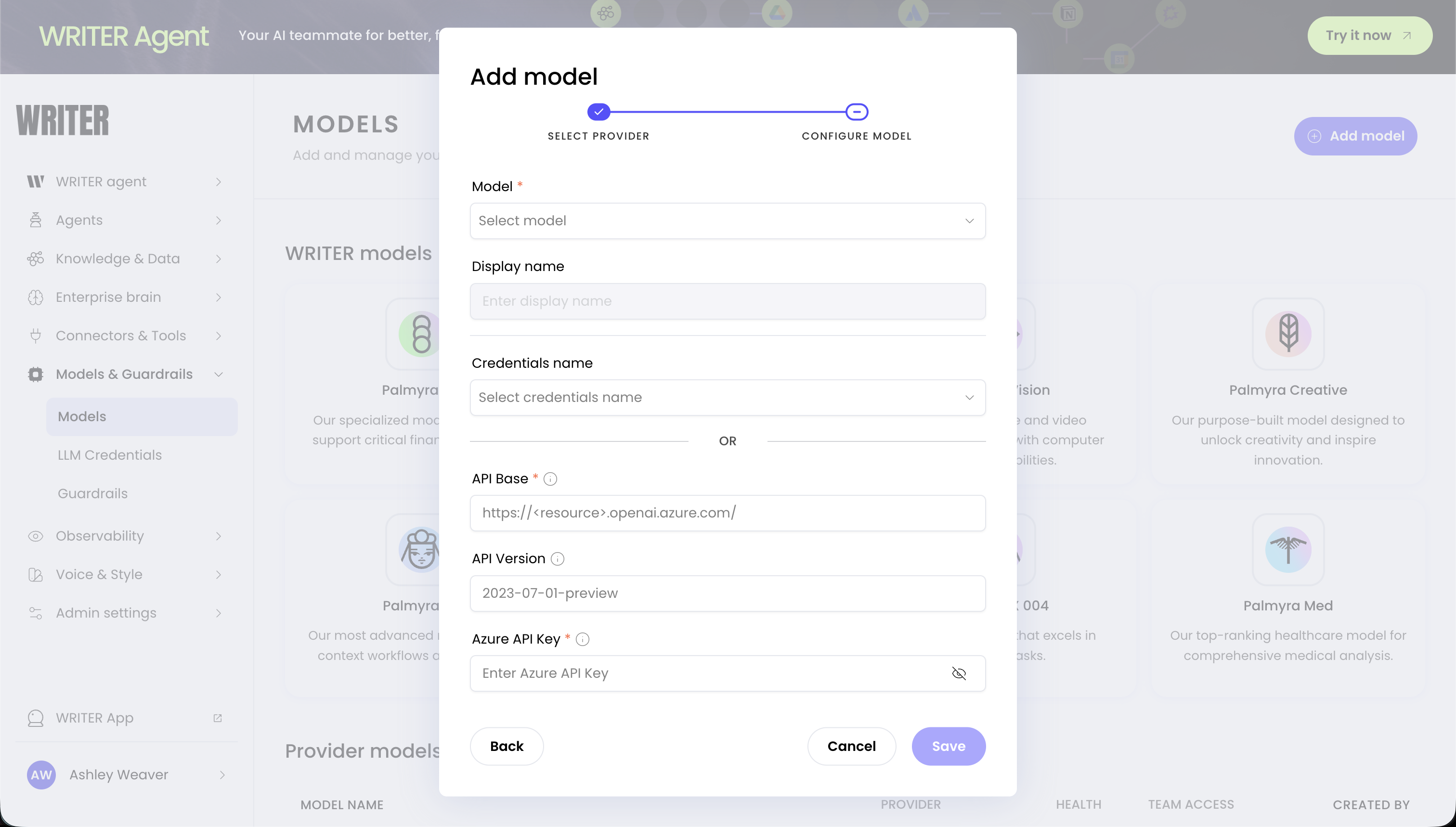
After deploying a model and copying your endpoint and key from either setup path:
1. Navigate to **Models & Guardrails > Models** in [AI Studio](https://app.writer.com/aistudio)
2. Select **+ Add model**
3. Select **Microsoft Azure** as the provider
4. Select your model from the **Model** dropdown
5. Enter your credentials:
* **API Base**: The Target URI from your deployment (for example, `https://your-resource.openai.azure.com/`)
* **API Version**: The API version to use (for example, `2023-07-01-preview`)
* **Azure API Key**: The API key from your deployment
6. Configure team access:
* **All teams**: Anyone with builder access can use the model
* **Specific teams**: Restrict to selected teams
7. Select **Save**
 ## Monitor costs
Azure bills usage directly to your Azure subscription based on tokens processed and deployment configuration. AI Studio also tracks usage and costs for external models, providing visibility into spending across all your models in one place.
For information about monitoring model health and automatic recovery, see [Monitor model health](/home/external-models#monitor-model-health).
## Troubleshoot Microsoft Azure configuration
### Invalid credentials error
If you see an "Invalid credentials" or "Authentication failed" error:
* Verify the API key is copied correctly without extra spaces
* Check that the key is still active in the Azure portal
* Ensure the key belongs to the same resource as the API Base URL
### Model not available error
If a model doesn't appear or returns an error:
* Confirm the model deployment shows **Succeeded** in the Azure portal or Foundry portal
* Verify the deployment name matches the model selected in AI Studio
* Check that the API version is supported for your deployment
### Connection failed error
If AI Studio cannot connect to your Azure resource:
* Confirm the API Base URL uses `https://` and matches the endpoint in your portal
* Verify the resource network settings allow public access
* Check [Azure service health](https://azure.status.microsoft/) for regional incidents
### Unhealthy model status
If a model shows as unhealthy in AI Studio:
* AI Studio automatically retries unhealthy models after a cooldown period
* For transient issues like temporary Azure outages, no action is needed
* For persistent issues, check the troubleshooting items above
## Next steps
* [Add external models](/home/external-models): Learn about managing external models in AI Studio
* [Choose a model](/home/models-overview): Compare Palmyra models with external provider models
* [Configure guardrails](/home/guardrails): Set up content safety and compliance policies for your AI agents
* [Deploy Foundry Models (Microsoft Learn)](https://learn.microsoft.com/en-us/azure/foundry/foundry-models/how-to/deploy-foundry-models): Full Foundry Models deployment walkthrough
## Monitor costs
Azure bills usage directly to your Azure subscription based on tokens processed and deployment configuration. AI Studio also tracks usage and costs for external models, providing visibility into spending across all your models in one place.
For information about monitoring model health and automatic recovery, see [Monitor model health](/home/external-models#monitor-model-health).
## Troubleshoot Microsoft Azure configuration
### Invalid credentials error
If you see an "Invalid credentials" or "Authentication failed" error:
* Verify the API key is copied correctly without extra spaces
* Check that the key is still active in the Azure portal
* Ensure the key belongs to the same resource as the API Base URL
### Model not available error
If a model doesn't appear or returns an error:
* Confirm the model deployment shows **Succeeded** in the Azure portal or Foundry portal
* Verify the deployment name matches the model selected in AI Studio
* Check that the API version is supported for your deployment
### Connection failed error
If AI Studio cannot connect to your Azure resource:
* Confirm the API Base URL uses `https://` and matches the endpoint in your portal
* Verify the resource network settings allow public access
* Check [Azure service health](https://azure.status.microsoft/) for regional incidents
### Unhealthy model status
If a model shows as unhealthy in AI Studio:
* AI Studio automatically retries unhealthy models after a cooldown period
* For transient issues like temporary Azure outages, no action is needed
* For persistent issues, check the troubleshooting items above
## Next steps
* [Add external models](/home/external-models): Learn about managing external models in AI Studio
* [Choose a model](/home/models-overview): Compare Palmyra models with external provider models
* [Configure guardrails](/home/guardrails): Set up content safety and compliance policies for your AI agents
* [Deploy Foundry Models (Microsoft Learn)](https://learn.microsoft.com/en-us/azure/foundry/foundry-models/how-to/deploy-foundry-models): Full Foundry Models deployment walkthrough